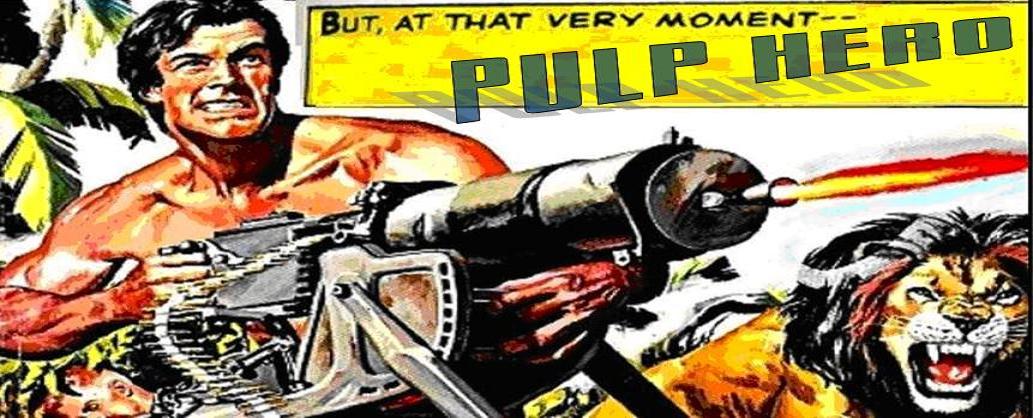

Generally, I see myself as a man who'd enjoy writing Pulp type stories, about a Pulp type  character, imbued with enough "timeless" qualities that they could be mistaken for more than they are, but still gratefully exactly what they are.
 character, imbued with enough "timeless" qualities that they could be mistaken for more than they are, but still gratefully exactly what they are.
  To that end, I've begun to put pressure on myself to accomplish a tough feat in today's "modern" culture: write books for men, about men, doing men kind of things. Right now, the publishing industry is rife with fiction for, about, and catered to women, particularly suburban women with children who turn Oprah's latest preferred author into a million seller overnight. All well and good, I've been told, and really I can't blame the publishers for targeting the one sure audience they are guaranteed in these here United States, particularly the East and West Coasts: women.
Popular fiction for men has dwindled steadily since the 1980s, the zenith of the "macho" novel series by writers like Don Pendleton and Warren Murphy, as well as the core of action movie cinema, both of which had taken on hysterical aspects until nothing was left but those aspects, such as the movies of Michael Bay (THE ROCK, THE ISLAND, BAD BOYS.) The "stay at home" mother tested her might by vaulting Stephen King into a stratasphere of popular success unrivaled in the 20 years following the cruel pelting of Carrie White with sanitary napkins on the first page of King's first published novel, CARRIE. Every girl's worst fear was realized, and King's innate ability did not specify gender views, but tapped into them. Men and women readers saw themselves in King's words, thus King remained one of the only writers of the modern era to successfully cultivate both the reality of American rural/suburban life and the fictional Pulp iconography of his childhood 1950s in an undeniable product. Where the Pulps may have arrested the attention of the pre- and post-War Americans prior to the arrival of the greatest threat to the written word in every American home (television), Stephen King's work in the selfish "Me Generation" of fast-food and easy-access became a compulsion in an already overstimulated society.
I've seen, in my near-forty years, a slow damning of the Pulp ideology, which in turn created the  sort of genres that boys could understand, like the Superhero. As has been pointed out ad nauseum wherever finer books are sold, without Doc Savage and the Shadow, in particular, Superheroes would not exist. Doc Savage and the Shadow were genetic fathers of Superman and Batman; their motifs spawned the Fantastic Four, which began the "Marvel Age" of comics. Today these characters are produced in movies which encapsulate hundreds of individual careers and generate tens of millions in revenue.
 sort of genres that boys could understand, like the Superhero. As has been pointed out ad nauseum wherever finer books are sold, without Doc Savage and the Shadow, in particular, Superheroes would not exist. Doc Savage and the Shadow were genetic fathers of Superman and Batman; their motifs spawned the Fantastic Four, which began the "Marvel Age" of comics. Today these characters are produced in movies which encapsulate hundreds of individual careers and generate tens of millions in revenue.
  Yet still does the idea of Pulp, from pulse-pounding adventure to lurid exploitation, find itself tethered to a male-centric stigmata. At this point in time, Pulp itself has begun to take on a shape, to form itself as its own genre, identified by a construct of forgotten memory, of late-night B-movies and Kung-Fu Theatres on Saturday afternoons, and the more poignant formulas of short, tersely-thrilling novels and tattered comic books from long ago.
There's been a barricade of technology obscuring the sweaty unknown dangers of Pulp, a  barricade of pop literature and celebrity accessible at all times to a hungering public. And yet the technology itself, the Playstation and the Xbox, lean heavily on the archetypal Pulp storylines and characters, their clarity and honesty. Audiences transport themselves into the core characters of video games who themselves are cyphers for adventures, both the pulse-pounding kind and the lurid. The technology supports the possibility that the Master Chief or the Hitman are Pulp archetypes as inviting and informing as the Shadow or the Whistler on radios of the 1930s.
 barricade of pop literature and celebrity accessible at all times to a hungering public. And yet the technology itself, the Playstation and the Xbox, lean heavily on the archetypal Pulp storylines and characters, their clarity and honesty. Audiences transport themselves into the core characters of video games who themselves are cyphers for adventures, both the pulse-pounding kind and the lurid. The technology supports the possibility that the Master Chief or the Hitman are Pulp archetypes as inviting and informing as the Shadow or the Whistler on radios of the 1930s.
 Of course I want to write books anyone can pick up and read, but I really want to write books anyone will pick up and read because there's a lot of crazy Pulp between its covers. Though steeped in formula, the Pulp novel/comic is as predictable as a tsunami...but still as powerful in scale. The potential to make an impact on the minds and hearts of readers is important to every writer, but the Pulp writer is maintaining a legacy which has existed at least since the Murders of the Rue Morgue. It's an important position, which requires a humble, dutiful attention, not slavish but inspired.
A lot of my favorite writers, Richard Stark and John D. MacDonald for instance, took a lifetime of  Pulp and infused it with an inevitable brilliance. The results were Parker, professional thief, and Travis McGee, salvage expert, respectively. The Pulp character had been electro-shocked by Stark (Don Westlake) and MacDonald's talent into a new, shining life, complete with literary import. Meanwhile, the movies, as they have always done, physicalized the Pulp Hero and made it even more palatable, in the form of Indiana Jones' and Luke Skywalker's eternal portraits.
 Pulp and infused it with an inevitable brilliance. The results were Parker, professional thief, and Travis McGee, salvage expert, respectively. The Pulp character had been electro-shocked by Stark (Don Westlake) and MacDonald's talent into a new, shining life, complete with literary import. Meanwhile, the movies, as they have always done, physicalized the Pulp Hero and made it even more palatable, in the form of Indiana Jones' and Luke Skywalker's eternal portraits.
 Recently there's been an upsurge in the genre of Pulp, as a genre in itself. Comics have spear-headed the movement, from Mike Mignola's inspired Hellboy to Eric Powell's wondrous Goon, to Ed Brubaker's CRIMINAL series. Along with them has come a fleet of new Pulp-inspired artist/writers, operating in the various theatres of technology, the Internet, the digital medium. All of them perceive the Pulp Genre, the iconography of Pulp as an art form. It's a fascinating status for Pulp in general, which of course I'd like to take the Nestea Plunge within myself. And I always have, since I was nine years old writing and drawing a comic book adaption of RAIDERS OF THE LOST ARK. I never finished it, and it became something else, something of my own. And I'm still trying to figure out how to finish what I started. It was a contract, an agreement signed in the blood of snakes and Nazis...and I must fulfill it.


 Posts
Posts


