
http://earthboundburlyman.blogspot.com/
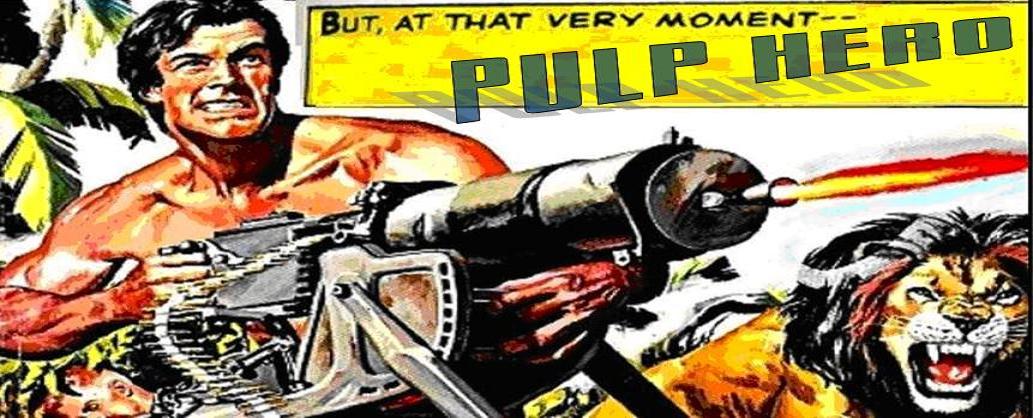
Join the burlier faction of the web. By the makers of Pulp Hero.
Chad

In mans evolution he has created the cities and
The motor traffic rumble, but give me half a chance
And Id be taking off my clothes and living in the jungle
cos the only time that I feel at ease
Is swinging up and down in a coconut tree
Oh what a life of luxury to be like an ape man
Im an ape, Im an ape ape man, Im an ape man
Im a king kong man, Im a voo-doo man
Im an ape man
http://listen.grooveshark.com/#/song/Apeman/8017268
http://www.spacebooger.com/ understands the pleasure of the feral.


 Out of Five 3D Men

 covers to the lurid paperbacks of the 1950s/1960s, and the poster art for some of the greatest films of all time, leading to the elevation of the comic book cover to another level as well.

 That wasn't the case in the 1970s, or farther back. See, the folks making movies and comics and television wanted to do everything in their power to convince you to see their product. They made clever trailers that didn't reveal anything, yet just enough to give any Horror/SF/Crime lover a massive rod-like projection in their pants to see the movie. Book covers of slender, tough novels about displaced private eyes and snake-eyed C.I.A. assassins, read by the extinct male reader, encapsulated their awesomeness by having a cover with a barely-dressed broad in stockings with a .45 in her hand getting ready to blow the head off a handsome tough with a cigarette dangling off his lower lip. Even porn movies and novels had experts working to convince the consumer they had to experience what they were selling.
 come up with a clever way of saying how much culture eats the pig offal straight out of the pig's ass. It's almost worth pointing out that my generation sh*t the bed where this is concerned, because it's my 1970s born/bred generation that allowed men like Bill Gates and his funky computers to overthrow the physical incarnations of art. Computer Generated Images have subverted everything we've ever believed. In fact, you can no longer trust anything you see or read anymore, can you? How do you know Bill Gates has not manipulated that image? How do you know that scanned book or novel or comic is the original version? How do you know anything, Neo?


 Out of Five 3D Men.
 Out of Five 3D Men.


 Frankly I find it almost offensive there isn't a regular monthly SAVAGE SUB-MARINER comic available. Here's one of the cornerstones of Marvel Comics, a character who's been around since the 1940s, relatively unchanged to this day. He's the inspiration (and superior) to Aquaman. One of the first legitimate "anti-heroes" in comic book history, Namor has fought hero and villain with equal ferocity in his existence. The Avenging Son has pasted every major Marvel character in the kisser at least once, which has to be some kind of precedent.

 The Question is a woman nowadays, but back in the 1960s he was a man (created, as was the Creeper, by artist Steve Ditko) who expounded the black/white worldview of Objectionism. Reporter Vic Sage's quest for justice enabled him to wear a special featureless mask designed by his friend Professor Rodor. The Question is a character with two fists and a very clear, very defined sense of right and wrong. "A is A." There is no middle ground, there is no "gray area" where it concerns morality and ethics. Either you ARE a criminal, or you are NOT a criminal. You make the choice.


 character, imbued with enough "timeless" qualities that they could be mistaken for more than they are, but still gratefully exactly what they are.
  To that end, I've begun to put pressure on myself to accomplish a tough feat in today's "modern" culture: write books for men, about men, doing men kind of things. Right now, the publishing industry is rife with fiction for, about, and catered to women, particularly suburban women with children who turn Oprah's latest preferred author into a million seller overnight. All well and good, I've been told, and really I can't blame the publishers for targeting the one sure audience they are guaranteed in these here United States, particularly the East and West Coasts: women.
 sort of genres that boys could understand, like the Superhero. As has been pointed out ad nauseum wherever finer books are sold, without Doc Savage and the Shadow, in particular, Superheroes would not exist. Doc Savage and the Shadow were genetic fathers of Superman and Batman; their motifs spawned the Fantastic Four, which began the "Marvel Age" of comics. Today these characters are produced in movies which encapsulate hundreds of individual careers and generate tens of millions in revenue.
  Yet still does the idea of Pulp, from pulse-pounding adventure to lurid exploitation, find itself tethered to a male-centric stigmata. At this point in time, Pulp itself has begun to take on a shape, to form itself as its own genre, identified by a construct of forgotten memory, of late-night B-movies and Kung-Fu Theatres on Saturday afternoons, and the more poignant formulas of short, tersely-thrilling novels and tattered comic books from long ago.
 barricade of pop literature and celebrity accessible at all times to a hungering public. And yet the technology itself, the Playstation and the Xbox, lean heavily on the archetypal Pulp storylines and characters, their clarity and honesty. Audiences transport themselves into the core characters of video games who themselves are cyphers for adventures, both the pulse-pounding kind and the lurid. The technology supports the possibility that the Master Chief or the Hitman are Pulp archetypes as inviting and informing as the Shadow or the Whistler on radios of the 1930s.
 Of course I want to write books anyone can pick up and read, but I really want to write books anyone will pick up and read because there's a lot of crazy Pulp between its covers. Though steeped in formula, the Pulp novel/comic is as predictable as a tsunami...but still as powerful in scale. The potential to make an impact on the minds and hearts of readers is important to every writer, but the Pulp writer is maintaining a legacy which has existed at least since the Murders of the Rue Morgue. It's an important position, which requires a humble, dutiful attention, not slavish but inspired.
 Pulp and infused it with an inevitable brilliance. The results were Parker, professional thief, and Travis McGee, salvage expert, respectively. The Pulp character had been electro-shocked by Stark (Don Westlake) and MacDonald's talent into a new, shining life, complete with literary import. Meanwhile, the movies, as they have always done, physicalized the Pulp Hero and made it even more palatable, in the form of Indiana Jones' and Luke Skywalker's eternal portraits.
 Recently there's been an upsurge in the genre of Pulp, as a genre in itself. Comics have spear-headed the movement, from Mike Mignola's inspired Hellboy to Eric Powell's wondrous Goon, to Ed Brubaker's CRIMINAL series. Along with them has come a fleet of new Pulp-inspired artist/writers, operating in the various theatres of technology, the Internet, the digital medium. All of them perceive the Pulp Genre, the iconography of Pulp as an art form. It's a fascinating status for Pulp in general, which of course I'd like to take the Nestea Plunge within myself. And I always have, since I was nine years old writing and drawing a comic book adaption of RAIDERS OF THE LOST ARK. I never finished it, and it became something else, something of my own. And I'm still trying to figure out how to finish what I started. It was a contract, an agreement signed in the blood of snakes and Nazis...and I must fulfill it.

 Posts
All Comments
Posts
All Comments


